

How to Improve Your Reading in Beach Volleyball — Play Smarter, Not Harder
You know that moment when the rally slows down in your mind? The serve leaves your hand, the opponent takes a step, and somehow you already know where the ball will land. That’s reading. It’s not luck or instinct—it’s a highly trainable skill, and it might just be the most powerful one in beach volleyball.
As a coach who’s been on the sand for a decade, I’ve seen the shift: the modern path to elite performance is paved with intelligent adaptation and decision-making, not just technical perfection. If you want to break through your performance plateau, you need to learn to read the game like a professional.
What “Reading” Really Means
Reading is more than just anticipation, it’s your ability to perceive and act at the same time (as discussed in the source document under “Developing Perception and Decision-Making“).
It’s your eyes, brain, and body working together to interpret what’s happening and prepare the right movement—often before you even have time to consciously think.
Perception-Action Coupling: The Foundation
Researchers like Rob Gray and Mark Renshaw describe this as perception-action coupling: your perception of the game and your movement decisions are connected, not separate. You don’t store hundreds of scenarios in your head, you recognize patterns and subtle cues through constant, realistic exposure.
The more game-like situations you face, the faster your system learns to adapt.
Reading = Anticipation + Movement + Decision
Anticipation isn’t guessing. It’s noticing subtle, critical cues—a shoulder opening, a foot angle, a tempo change—and adjusting your movement before the ball even leaves the hand.
That’s the art of reading.
Why Traditional Drills Don’t Improve Reading

If you’re stuck doing the same predictable, repetitive drills, you’re missing the point. Most drills feel clean, isolated, and easy. You know where the ball is coming from, how fast, and exactly where it’s going.
The problem? Real matches are never predictable.
Blocked, repetitive practice creates the illusion of progress—you get better at the drill, not at the game. When every repetition looks the same, your brain stops adapting and developing the versatility needed on the sand.
You might look technically perfect in practice, but once the wind changes, the sun is in your eyes, or an opponent surprises you, that perfection disappears.
To improve decision-making and perception, you must train under conditions that resemble actual competition.
Train the Way You Play: The Ecological Approach
The best way to improve your reading is to make practice look, feel, and sound like the game itself. That’s the core of the ecological training approach: instead of isolating skills, you design learning environments that represent reality.
1. Start from Real Situations
Begin every drill with a serve, a dig, or a free ball—never a perfect coach’s toss. You must incorporate the reading and movement that precede the actual skill.
2. Add Context and Variability
Reading thrives on chaos. Elite skill develops through constant exposure to realistic play situations under variable conditions.
- Train under wind, sun, and on different surfaces to enhance your adaptability.
- Use modified challenges such as changing court size, score, or time limits to encourage problem-solving and quicker decision-making.
3. Play Small-Sided Games and Constraints
Game-like scenarios are designed to improve real-match performance and teamwork.
- Small-sided games (e.g., 1v1 or 2v2 on a modified court) increase touches and force continuous communication and reading of space.
- Use constraint-based tasks that require players to discover solutions rather than follow fixed instructions. For example, “you can’t hit twice in a row” or “score only with a soft shot.” Constraints force creativity and perception.
Simple Ways to Improve Your Reading Today

Stop overthinking and start seeing. Here are actionable steps you can implement immediately to sharpen your perception and decision-making on the court, transforming how you anticipate and react during play.
- Play More Game-Like Situations. The most effective way to enhance your reading ability is to integrate more game-like scenarios into your practice routine. Every single touch of the ball should involve a decision-making process, mirroring the complex choices you face in real competition. This means moving beyond static drills and creating dynamic environments where you constantly assess opponents, ball trajectory, and court space to make informed actions.
- Focus on Cues. Train your eyes to go beyond just watching the ball. Consciously observe your opponents’ hips, shoulders, and approach angles before they make contact. These crucial body language cues are often reliable indicators of where the ball is likely to go or what type of shot is coming, giving you a vital fraction of a second to anticipate and position yourself effectively.
- Mix Your Training Partners. Regular exposure to different playing styles is fundamental for developing adaptable reading skills. Training with a variety of partners and opponents forces your brain to constantly adjust its predictive models and communication strategies. Each new style presents a unique set of challenges, pushing your perceptual system to become more flexible and robust.
- Watch Video the Smart Way. Don’t just passively consume video. To truly leverage this tool for improving your reading, pause the footage just before an opponent makes contact with the ball, whether it’s an attack or a serve. At this moment, actively try to anticipate the shot, predicting its direction, speed, or type. Then, resume playback to check if your prediction was correct. This active, “predict-and-check” method powerfully trains your pattern recognition and decision-making under pressure.
- Embrace Uncertainty. View challenging conditions as opportunities for growth. A windy day, a new and unfamiliar partner, or a less-than-perfect court surface should not be seen as obstacles, but as ideal training grounds. These variable environments are the “jungle” where real, adaptable skills truly flourish, forcing you to develop creative solutions and heighten your perceptual awareness.
Make Uncertainty Your Teacher
Reading thrives in variety and unpredictable conditions. When the environment or circumstances change—be it the weather, different opponents, or shifting game dynamics—your perceptual system is forced to become more flexible and responsive.
This enhanced flexibility is precisely what makes the difference and ultimately wins matches on sand, allowing you to adapt seamlessly to whatever the game throws at you.
Learn from the Best: See Better, Not Guess Better
To truly master the art of reading in beach volleyball, observe elite players closely. Icons like Anders Mol, Eduarda “Duda” Santos, and April Ross demonstrate a fundamental truth: they aren’t faster because they guess better, they genuinely see better.
These athletes have dedicated years to intense exposure to endless game scenarios, meticulously building a vast, unconscious database of movement solutions within their minds and bodies.
As motor-learning research (Gray 2020, Wulf & Lewthwaite 2016) consistently shows, your body learns complex patterns through active interaction with the environment, rather than through mere instruction or rote memorization.
Reading, in essence, is a living skill – it continuously grows and refines itself with every serve you receive, every challenging dig you execute, and every chaotic ball you chase down on the sand. This ongoing, experiential learning process is key to developing truly superior court vision.
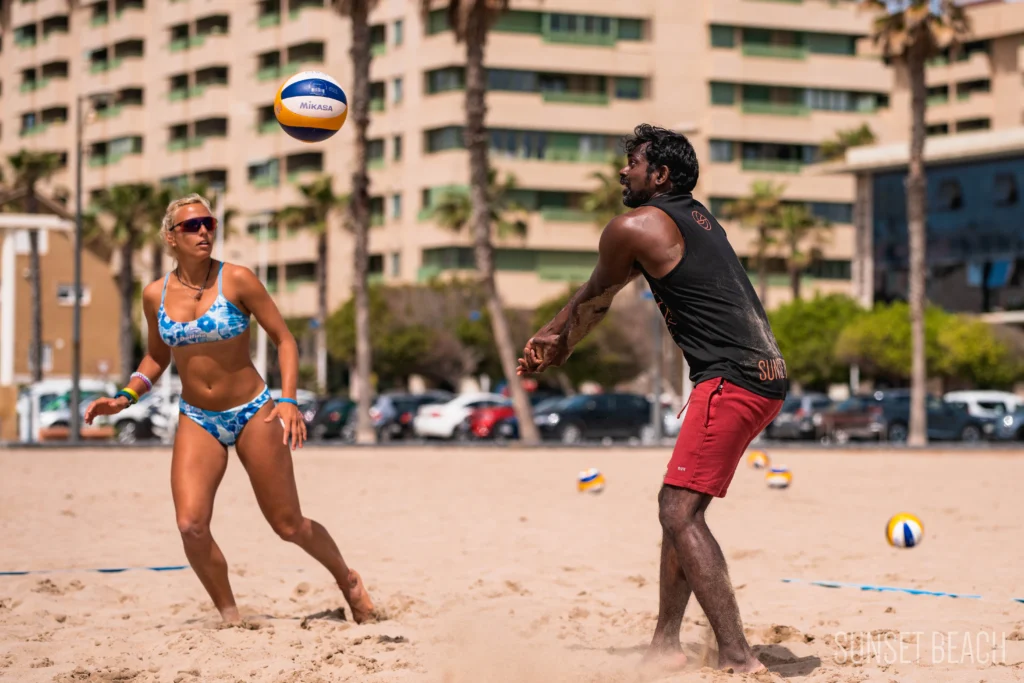
The Sunset Beach Way: Mastering the Art of Reading
At Sunset Beach Camps, true improvement comes from immersing players in dynamic, realistic environments. This is why reading isn’t just another drill — it’s an integral part of every single session.
Separating reading into isolated exercises creates an artificial learning scenario that doesn’t translate to real game performance. Instead, we weave perception and anticipation into the very fabric of our training philosophy.
Our highly experienced coaches are dedicated to designing practices that consistently challenge perception and decision-making through real, competitive, and above all, fun play.
We move beyond predictable, repetitive patterns to create scenarios that demand constant awareness, quick analysis, and strategic choices.
This approach ensures that every player is actively engaged in interpreting the game, fostering a deeper understanding that goes beyond mere physical execution.
We help you discover what works best for you in real-game conditions.
Our coaching emphasizes adaptability and finding personalized solutions that are robust under pressure, rather than imposing a rigid, one-size-fits-all model.
Our philosophy is encapsulated in our mantra: “We coach what we see.”
This means our guidance is always rooted in direct observation of your performance within game-like situations. We provide immediate, relevant feedback based on your actual decision-making and execution during dynamic play, helping you to understand the ‘why’ behind your actions and refine your strategies in context.
Ultimately, this methodology for developing superior reading skills is simple, authentic, and profoundly effective.
By prioritizing realistic game play, personalized adaptation, and responsive coaching, Sunset Beach Camps offers a truly impactful approach to mastering the mental and physical demands of beach volleyball.
Takeaway
If you want to read the game better, you must train like you play. Expose yourself to unpredictable rallies, new partners, and changing environmental conditions. Your brain will adapt—because that’s what it’s built for.
- Every serve is a lesson.
- Every rally is feedback.
- Every mistake is information.
Train with purpose, freedom, and challenge. Join programs that prioritize decision-making, game awareness, and contextual practice over isolated drills.
That’s the ultimate path to becoming a smarter, more successful beach volleyball player.
Ready to elevate your game with purpose? Join Us on the Sand
Train in environments that feel like the game, not like a lab. Challenge yourself, adapt, and enjoy the process.
