

Train Like You Play — How to Do It Better
In the dynamic world of beach volleyball, the pursuit of mastery isn’t about rigid adherence to a single method. There’s no single “right” way to train, and that’s the beauty of it.
Every player brings a unique set of skills, every partnership develops its own rhythm, and every beach presents its particular challenges.
However, there are undeniably better ways to design training – approaches that genuinely prepare you for the unpredictable reality of the real game, rather than for a flawless, controlled version that simply doesn’t exist.
Because in beach volleyball, the ever-shifting sand, the unpredictable wind, the relentless pressure, and even the nuanced interactions with your partner are not just elements of the game, they are, in fact, integral parts of the lesson itself.
Why “Train Like You Play” Matters
The philosophy of “Train Like You Play” is often misunderstood. It doesn’t mean copying matches point by point or engaging in endless scrimmages.
Instead, it means consciously connecting every aspect of your practice with the visceral reality of the game – infusing it with the same critical decisions, raw emotions, and crucial information your body needs to perceive and act upon spontaneously.
Too often, traditional training happens in a sterile vacuum: predictable tosses, perfect weather conditions, and clean, isolated repetitions. This creates an artificial sense of mastery. But in the crucible of real matches, the ball never comes perfect. You are constantly forced to adjust, adapt, and respond creatively to the inevitable chaos.
That’s what “train like you play” truly means – not a quest for control, but a journey toward profound adaptability.
The goal isn’t perfection — it’s preparation for imperfection.
Learning Happens in Context
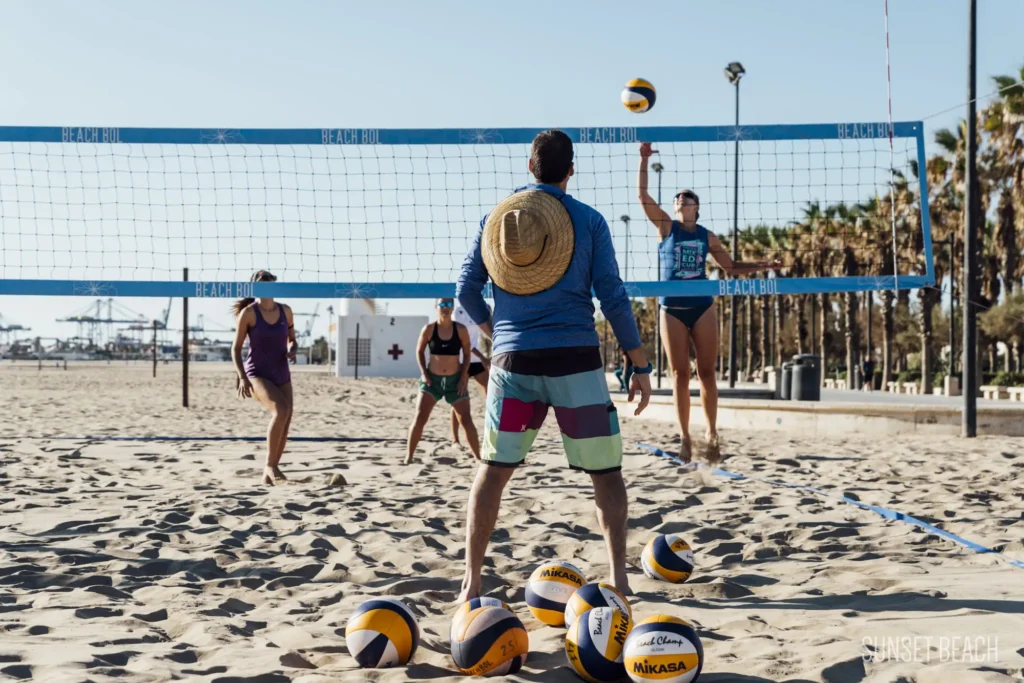
Your brain is not designed to learn in isolation. Rather, it learns most effectively by actively interacting with its environment.
When you engage in training that strips away this vital context, you are, in essence, leaving half the potential learning on the table. Every element of the game – from the intensity of the light and the direction of the wind, to the mental pressure of the score and the surrounding sounds – fundamentally changes what you perceive and precisely how you move.
The brain thrives on this variability, needing that constant input to form flexible, robust, and lasting movement patterns.
That’s precisely why elite players don’t merely repeat actions; they actively explore. They test boundaries, make subtle adjustments, and continually discover dynamic solutions that perfectly fit their evolving game.
There’s no single, prescriptive way to “do it right” – only smarter ways to intentionally create conditions that help you learn better, faster, and more deeply.
Designing Better Practice
So, what does this “train like you play” philosophy look like in real-life application? Here are actionable strategies to integrate into your sessions:
- Start with reality. Immediately immerse yourself in game conditions by beginning every activity from a live serve, a challenging free ball, or a chaotic transition play. This instantly activates the crucial perception-action cycle.
- Use constraints. Intentionally limit options to naturally highlight desired behaviors. For example, instruct players to “attack only line,” or “play everything short”. Constraints force creative problem-solving and enhance specific skills under pressure.
- Change the space. Manipulate the physical environment. Utilize smaller courts to demand precision, practice on deeper, more challenging sand to build resilience, or purposefully train during windier sessions to sharpen perceptual skills and balance. Each alteration changes how you perceive information and make decisions.
- Add a score or challenge. The simple act of keeping score fundamentally changes everything – how you focus, how you move, and how effectively you communicate with your partner. Introduce specific challenges like needing to win three points in a row or playing to a specific target score to elevate the pressure and engagement.
- Reflect. After each rally or game, engage in purposeful reflection. Ask yourself and your partner: “What did I see clearly? What cues did I miss? How did the environment or opponent change, and how did I respond?” This metacognitive process is where true growth and understanding happen.
The environment itself is often the most profound coach – you’re simply there to listen and respond to its endless lessons.
Repetition Without Repetition
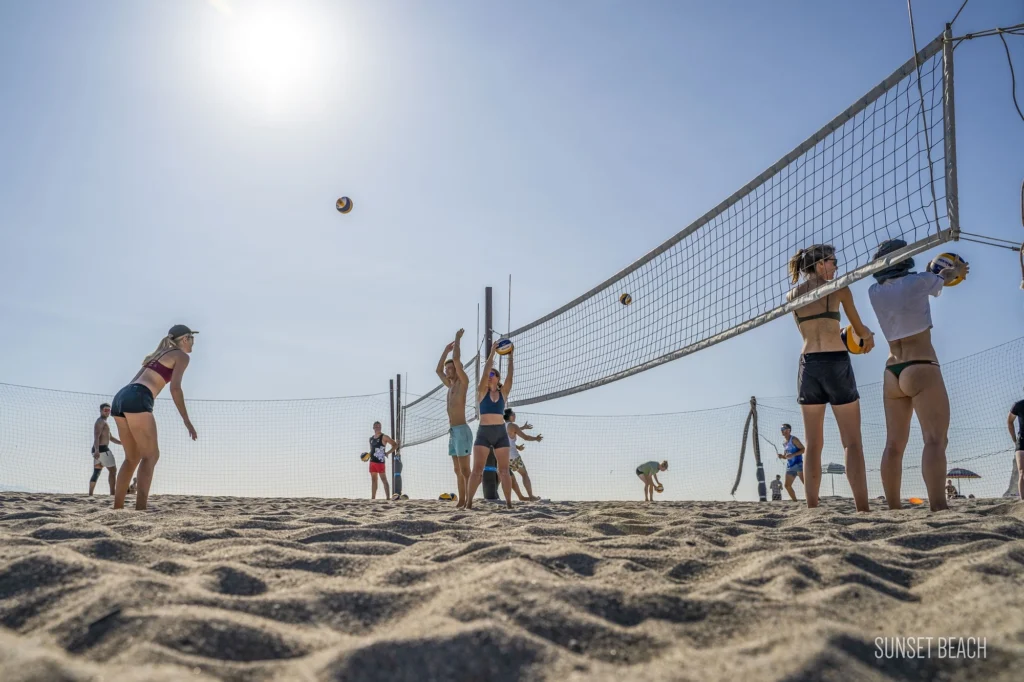
As the legendary tennis player Rafa Nadal once profoundly stated, “The bounce of the ball is never the same twice.”
This perfectly encapsulates the reality of dynamic sports – every moment is subtly different, presenting a slightly new challenge. Your inherent ability to adapt to these constant micro-variations is precisely what elevates your game.
Therefore, real improvement doesn’t stem from mindlessly doing the exact same thing over and over. Instead, it comes from continually facing similar situations that never feel quite the same.
This is the powerful concept of “repetition without repetition” – the fundamental cornerstone of learning in dynamic sports like beach volleyball.
Every serve you receive, every dig you make, and every rally you engage in gives you a slightly new problem to solve.
And, the more genuine variation you face in your training, the better and faster you become at solving those problems quickly and creatively when it truly counts.
The Role of Emotion and Focus
Training isn’t merely a physical endeavor, it’s deeply psychological and emotional. The most profound and lasting learning occurs when you genuinely care, when there’s meaning attached to what you do, and when the stakes feel real.
This insight is powerfully reinforced by the OPTIMAL Theory of motor learning, which clearly demonstrates that autonomy (feeling in control), enhanced motivation, and a laser-like focus on external goals (like sending the ball to a specific spot, rather than thinking about your arm swing) significantly boost both performance and long-term retention of skills.
In simple terms: if your practice sessions feel like an engaging challenge you genuinely want to win, your body and mind learn at an accelerated pace.
Therefore, intentionally create training environments that evoke real emotions – moments of intense competition, profound curiosity, or sheer excitement.
That’s the type of meaningful experience that truly transfers to the court when it matters most.

The Sunset Beach Way
At Sunset Beach Camps, our philosophy is clear: we don’t separate training from the game; we actively bring the game into training. This means our sessions are infused with all the vibrant elements of real beach volleyball – the warmth of the sun, the energy of the noise, the pressure of competition, the joy of laughter, and the constant thrill of problem-solving.
You won’t find endless lines of players waiting their turn or rigidly scripted, isolated drills. Instead, you’ll discover dynamic challenges, engaging games, and a guided approach to discovery that empowers you to learn in your own unique way.
There isn’t one singular model of a “perfect player” – there are, in fact, countless beautiful and effective ways to master this sport. Our ultimate job is to help you uncover and refine yours.
We don’t coach to control, we coach to connect.
Connecting you more deeply with the game, with your partner, and with your own innate abilities.
Takeaway
It’s time to redefine your approach to improvement. Training like you play isn’t about meticulously copying matches point for point.
Instead, it’s about thoughtfully creating training environments that feel authentically alive – unpredictable, emotionally engaging, and deeply meaningful.
Because the more alive and real your practice is, the more your hard-earned skills will truly come alive when you step onto the court to compete.
There’s no single “right way” to train – only consistently better ways to learn, to explore, and to genuinely enjoy the beautiful game of beach volleyball.
Join Us on the Sand
Are you ready to experience training that feels real, challenging, and profoundly rewarding?
Experience training that feels real.
Challenge yourself, adapt, and grow in environments meticulously designed for you – not against you.
👉 Find your next Beach VolleyBall camp in Spain →
